Wednesday, November 23, 2011

Tribation Abstracal

Project 2: earth art
Objective- make art of that which mother nature has provided
Carillo and Mahmoud. Tribation Abstracal. 2011. Dry maple leaves, palm frawns, white rose petals, olive branches, twigs, mushrooms, and varoius other leaves, 30m X 6m. Cypress College Campass, California. 

Interpret as you wish.....


Tuesday, November 1, 2011

Francisco José de Goya y Lucientes


 Self-portrait. 1795. Indian ink and wash, 15.2 X 9.1cm. Metropolitan Museum of Art, New York City.
Charles IV of Spain and His Family. 1800. Oil on canvas, 280 x 336.
Portrait of the Duchess of Alba. 1797. Oil on canvas, 210 X 149 cm.
  El Qitasol. 1777. Oil on linen, 104 cm X 152cm.
La Maja Desnuda. 1800. Oil on canvas, 98 X 191 cm. 
La Maja Vestida. 1803. Oil on canvas, 95 X 190 cm.
Corral de Locos. 1794. Oil on plated iron, 43.8 X 32.7 cm. 
El Tres de Mayo. 1814. Oil on canvas, 266 X 345 cm.
Saturno Devorando Su Hijo. 1819-1823. Oil on canvas, 146 X 83 cm.
Manuel Asenjo. Fotografia de la Quinta del Sordo. 1900. 
Hasta la Muerte. 1797-98. Etching and aquatint, 7 1/2 X 5 1/4". 
 Casa de Locos. 1800. oil on wood panel. 
Pilgrimage to San Isidro. 1819. Oil on canvas, 140 X 438cm. Museo del Prado, Madrid.
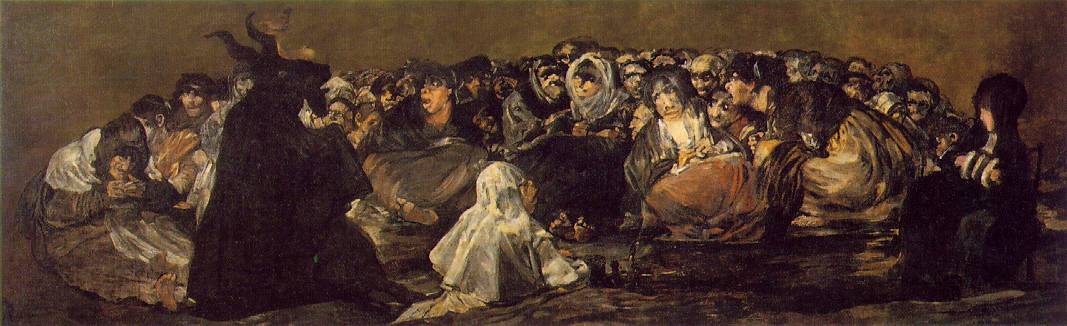
Witches' Sabbath. 1821-1823. Oil on canvas, 140 X 438cm.

Tuesday, October 18, 2011

"Turn off your Gestalt Processor"

In Psychology An Explantion, Saundra K. Ciccarelli and J. Noland explain, "Gestalt (Gesh- TALT) is a German word meaning 'an organized whole' or 'configuration,' which fit well with the focus on studying whole patterns rather than small pieces of them." The familiar slogan, "The whole is greater than the sum of its parts." sums up the Gestalt principle. We generally look for whole patterns and use top-down processing, using prior knowledge to infer what the outcome will be.  We naturally want the whole instead of the parts. Bottom-up processing gathers small bits and pieces to eventually put a whole together; this is the exact technique used during the contour drawing of a businessman during class.
Dividing the picture into six horizontal segments and flipping the picture so we actually started from the bottom and worked our way up, each student drew various lines that eventually created the image of a businessman. By only providing a given set of lines at a time, one is forced to take the pieces and not the whole. Drawing is really just creating various lines to make up an image. Essentially anyone is capable of drawing well. It's a matter of taking it line-by-line and practicing over and over. 

Wednesday, October 12, 2011

empty......


Craft and art have been confused, interchanged, and combined for years. The line between art and craft was rather unclear to start with and has only blurred even
more so over time. Craft derives from that which is hand made,
 but in that case most art is craft. Some believe what
distinguishes art from craft is that craft is functional, but
that's not the case either. Typically we depict certain
 works as craft due to the materials used. Clay, glass,
 metal, wood and fiber are the commonplace
materials used in crafting. Peter Voulkos used
stoneware and glaze to create an untitled stack
 pot in the year 1964 measuring 30 feet high. This
 work is considered craft because of the material
used. But by no means is it functional; it has a
gash that deems it unfit for containing much of
anything. It is empty and will remain so. Voulkos
asks that we find to be of some greater purpose,
as and object of art subject to questioning. The
empty vessel is a victim of violence with scars of
 destruction. When clay is fired it loses its plastic nature and
 is no longer moldable; what you fire is there to stay. The cutting,
 tearing, slicing,                                      ripping, and other subtractive actions can no longer be mended.                                                        Even the glazing is done in a manner that suggests little                                                                       tranquility. Oliver Herring's work, Castle, is also
                                                                                   unsettling. It comes from a series known as
                                                                                     A Flower for Ethyl Eichelberger. Castle was
                                                                                        knitt of transparent Mylar measuring
                                                                                        9 X 47 X 65". It depicts a bed with the
                                                                                        impression of a coat. It is meant to signify
                                                                                            absence and loss. Eichelberger was a
                                                                                               performance artist that had commited
                                                                                               suicide while dying of AIDS. Great
                                                                                               sorrow is felt through the work when
                                                                                              you begin to realize the grief of the
                                                                                             artist and the long suffering left to
                                                                                            endure. The impression of the coat will
                                                                                          always remind but never return what has
                                                                                         left. A coat and bed both suggest comfort
                                                                                     and warmth, but this piece offers neither. 

horsing around

Alexander Calder. Ordinary. 1969. Painted steel, 19' X 19'8 3/16" X 19'. 

Luis Jimenez. Vaquero. Modeled 1980, cast 1990. Acrylic urethane, fiberglass, steel armature, height 16'7". Smithsonian American Art Museum, Washington D.C.

The father of the mobile that is Alexander Calder and an artist embracing contemporary materials for contemporary art, Luis Jimenez, have constructed pieces with amazingly captivating qualities. The works create movement and suspense using dynamic concepts. They use 3 dimensional properties to the greatest potential. And they bring an interesting perspective to the world of play.
Calder viewed art as "a kind of serious play for a adults". He came up with a new toy, the mobile. He also created stabiles, and pictured above he fashioned hybrids. Calder used simple shapes and colors and the power of balance to create phenomenal works on a large scale. Ordinary teeters in the wind causing the simplest flow of air to create an interesting sensation. It emphasizes simplicity in everything that it is and does.
Vaquero is brilliant, fun, and daring piece of work that celebrates the American west and remind us of the original influence of the Mexican culture. This daring composition isn't even possible without the help of the steel armature that holds it in place. The acrylic urethane works wonders to enhance the fluid movement of the sleek lines. The raw power of a bucking horse is prevalent and continues on in the wild vaquero holding on. I can really appreciate this work because I created a similar figure as a hood ornament, so i understand the work that is put into a model that doesn't even stand on its own. 

Tuesday, October 11, 2011

spider sense and puppy love

Louise Bourgeois. Maman. 1999. Bronze, steel, and marble; height 30'.
Jeff Koons. Puppy. Installation at Schloss Arolsen, Germany during Documenta IX, 1992. Live flowering plants, earth, geotextile, and internal irrigation system. 

Sculptures and installations take art to another level, or rather dimension. You walk around them, stare up at them, walk through them; there is a much stronger interaction and engagement with the viewer than a two-dimensional piece has to offer. Both of the works above are sculptures that have toured the world, engaged a large audience on various continents, and are larger than life renditions of common creatures with interesting concepts behind them.
Maman, which is French for mother, is a 30-foot spider accompanied by a smaller spider simply named Spider. This sculpture can be rather daunting, for arachnophobia is rather common. However the artist's intent is the exact opposite. Bourgeois compared a mother from the view of a child to a spider. Both are "awesomely tall, protective, patient, and skilled." Immediately after viewing the photo of the sculpture and discovering the title to be Maman, I thought of "The Other Mother" from CoralineI find this to be a more accurate rendition of my mother =P The Other Mother is also referred to as a beldam, an ugly old woman. She collects children and sucks the life out of them. Maman and "The Other Mother" are two mothers depicted as spiders with very different perspectives. 
You can't help but love Puppy. It's a West Highlander Terrier made of flowers! Take the Caesar dog food commercials; the dog is so cute you have to buy the food (and the dog). Why do we buy flowers? Why in the world is there a career fashioned simply to serve bouquets of flowers? We, as a society, are suckers for that which we deam cute. And that was a major part of the concept behind Puppy. Koons took the idea that the more sophisticated "high art" admirer is supposed to frown upon the sentimental and adorable somewhat "simplictic art and blew it into giant proportion. How absurd of us to allow vanity to overwhelm?

the art of everday life

Finding art in that which you view everyday takes a certain eye. To find meaning and value in said artwork can prove even more difficult (unless you're good at pulling things out of thin air and making them sound convincing.) I rather enjoyed roaming around Cypress College campus looking for art. I also enjoyed what other groups found as well as what they had to say about them.
Some groups picked "obvious" works of art and some went a little deeper. Some put thought into they're choice (or at least it seemed so) and some not so much. Nonetheless it was interesting to see how things one may see on a daily basis can pose new questions and serve various purposes. 
This field trip conjured many questions, both new and old. What is art? How are the elements of art used to define a piece? Who decides what is and isn't art? Where can art be found? Why are certain works created? When and where are the optimal time and location to view a piece? What different types of art exist? How can they co-exist within the same work? The questions really are endless. The answers? Those are a bit more difficult to come up with. 
I'm learning so much, but at the same time I'm not learning anything. It brings to mind a tattoo that refers to a quote, "...ever learning and never able to come to the knowledge of the truth."