Friday, September 30, 2011

graffiti


Above are results from a little field trip I took on Thursday, September 29. Graffiti. Good? Or bad? Artistic expression? Or vandalism? Graffiti comes from the word graffito meaning to expose lower layers by means of scratching or carving. Nowadays it's typically meant to refer to painting on property. Free-hand spray painting, stencils, stickers, wheat pasting, and etching are just some of the methods employed in today's street art movement, a movement that is taking place world wide. Graffiti is even moving into the gallery scene.
From little rascals scribbling on a wall with a can they managed to get their hands on to middle aged, working citizens who'd like to share their skills with the world, just about anyone can partake in this global phenomenon. And people from every continent are indeed doing just that. Whether it be for the thrill and excitement of doing something illegal, saying to the world "I'm here", making a political or social statement, sharing free art for all to see, or just messing around, people seems to enjoy creating graffiti. Some enjoy it so much that they are willing to serve jail time and even die to have their work out there. Some travel around the world to have their works surround the globe.
And then there are people who hate it. It's vandalism. It's destruction of property, personal or public. It's "ugly." It's offensive. It leads to crime. One even said, "It's a gateway crime." Ironically enough one of the groups against graffiti is known as T.A.G., Totally Against Graffiti. I don't have much to say against graffiti, so I'll stop there.
I love graffiti in all it's various forms. The aesthetically pleasing murals are easy to enjoy, but I also find a particular beauty in the "ugliest", illegible, crudely executed tag. The background picture to this blog is of my arms covered in sharpie. I did this about 4 years ago. I gave people a arsenal of sharpies and told them to do as they pleased with them on my arms. One guy even drew a penis on my bicep, but it's not visible in this picture. =P And I had this all over my arms during winter break. Sometimes you just have to go with it. What I do not enjoy is when people paint over graffiti with the most ill fitting colors that make it so obvious that they are covering graffiti. What makes a block of paint better than the work that was there before it?

Tuesday, September 27, 2011

"the unexamined life is not worth living"

The Razor's Edge, a 1984 post-war film, concerns the search for enlightenment. Marina Abramovic, a New York based Serbian performance artist, explores limits, fears and identity. Yves Klein, the artist responsible for A Zone of Immaterial Sensibility, draws on "The Void." And Dadaism throws logic and reason out the window. Only love can be heaven and hell. So...... what does it all mean? What is the point? And how are we supposed to live our life?
Any influential artist doesn't just paint a pretty picture. For an artist to have any real impact, they must cause the viewers to think, puzzle and mull things over. Usually the viewer asks questions applicable to the art work as well as the artist and perhaps methods used and methods intended, however the desired application is toward the viewer themselves. The wanting comes in waves. Ask yourself questions. You might not know the answer now. You might not ever know the answer. There isn't one right answer. The goal is simply to ask.
Why do you do what you do? 'Cause you've always done it? 'Cause people before you did it? 'Cause you're supposed to? 'Cause everyone else does it? I don't have the answer. Does anyone? Maybe so, maybe not. Hope that they follow. Just stop, think, and ask yourself a question, esoteric or mundane. Just ask. Just do. Just because.

tension rises

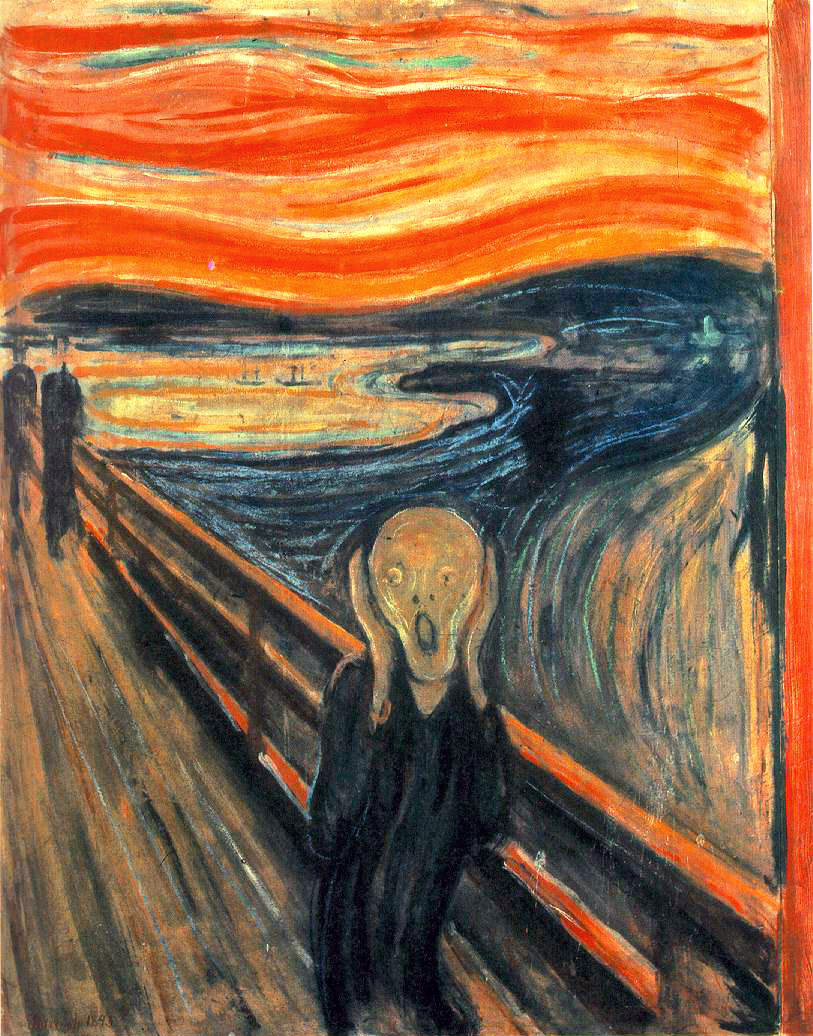
First off, I love, love, love this painting and have for quite some time.


Edvard Munch. The Scream. 1893. Tempura and casein on cardboard, 36 X 29". Munch-Museet, Nasjonalgalleriest, Oslo.
From the subject matter to the brush strokes to the colors, The Scream, quite simply, screams. The bloody red sky evokes horror, anguish and pain. Here a very open palette is used, but the complementary color harmonies that are very near to each other, the reds touch greens and the oranges lie adjacent to blues, intensify each other. The swarming lines of the landscape background nearly obliterate a horizon line. The diagonal bridge creates even more unsteady tension. The harsh brushstrokes of bleeding colors magnify the tension to an even greater level. And finally the focal point, with such shock upon its face, screams in sheer terror. 

Theodore Gericault. The Raft of the Medusa. 1818-19. Oil on canvas, 16' 1 3/4" X 23' 9". Musee du Louvre, Paris. 
Diagonals are also heavily prevalent in The Raft of Medusa. Nearly all the lines of the distressed bodies  are diagonal in orientation. The ropes and sail, too, are at diagonals. The steadying line of the horizon is nearly entirely obstructed from view. The stormy clouds, thrashing sea, and withering bodies all depict agony and torture, which is only to continue for the wind is carrying the raft away from any and all hope of survival the men may have when sighting a rescue ship in the distance. 

moving along

Giacomo Balla. Dynamism of a Dog on a Leash. 1912. Oil on canvas, 35 3/8 X 43 1/4". Albright-Knox Art Gallery, Buffalo, N.Y.
Movement is the first thing to come to mind when viewing this painting. The subject walking a dog on a leash is not actually moving, but the sense of motion is certainly portrayed. This effect is achieved by painting different frames on one canvas. The concept is similar to a flip book, but here it's condensed to one page. The  diagonals of the background further emphasis the dynamism of the speed and energy of the subjects in the foreground. Balla was an artist that encapsulated the idea of the art movement referred to as Futurism. Futurism is meant to revere motion, speed, energy, and daring. The shapes are not particularly defined, but rather vague. In junction with the paws and feet, they work marvels for the emphasis of the piece. Much like shape, the muted texture in the foreground helps enhance the background. The blurred paws and feet  give the idea of hurried motion and pressed time. The daschund's  tail whips through the air excitedly. Even the leash moves like double dutch jump ropes. The colors aid in the creation of the energy perceived. Had this painting been completed in more vibrant colors, it would sorely distract. This is a simple painting with amazing energy.     

Judy Pfaff. Cirque, Cirque. 1992-95. Construction of handblown glass orbs, and other materials. Permanently installed at Pennsylvania Convention Center, Philadelphia.
Movement also comes to mind with this piece, but not in the same manner. This installation draws greatly on the power of lines. Instinctively we wish to follow lines, perhaps in search of an origin or end. Through loops and twists and turns our eye follow lines and create the movement in the piece. The sheer size also adds to the overall excitement the piece intends to invoke. The soft curves and many circular shapes encourage the eyes to continue in movement. Like the Dynamism of a Dog on a Leash the piece is not moving, but it possesses great energy.

Saturday, September 24, 2011

a rippling surface


 Robert Smithson. Spiral Jetty. 1970. Rock, salt crystals, earth, algae; coil length 1500'. Great Salt Lake, Utah.


Bridget Riley. Song of Orpheus 5. 1978. Acrylic on canvas, 6'5" X
8'6 1/4". Museum of Fine Arts, Boston.


The works are completely different in color, size, medium, and execution but they share many subtle qualities. Spiral Jetty is an earthwork. It's made from earth, rock, salt crystals and algae. It's displayed in nature. It's meant to evolve with nature. It's organic in nature. The spiral is a symbol of life. It comes in two's, positive and negative. Visually it continues on, but we do know there is a halt, an end, a disruption. This work disrupted the lake to an extent but it is meant to live with it now, changing over time.  The water outside ripples and that inside is calm and level. It draws on the balance we must find in life. External turmoil and inner peace, water and earth, beginning and end, we must balance it all. The work is monumental in size, but the subtle details are what breathe life into it. The glistening shimmers show in violets, pinks, and reds.
Pink, blue, lavender, and golden ocher are the colors that flow through Riley's Song of Orpheus. Here the details are what make the piece monumental. Each line of color alone has an effect that is nearly nonexistent in comparison to the piece as a whole. The movements of the ribbons of color ripple like the water outside of the spiral in the Spiral Jetty but it also soothes and calms like the water inside. It's optically appealing with deceptive simplicity. The size of the piece contrasts its quiet design. It consumes and consoles. The music the movement exudes is sensuous and alluring even.

dead shortly and long dead


Horace Pippin. John Brown Going to His Hanging. 42. Oil on canvas, 24 1/8" X 30 1/4". The Pennsylvania Academy of Fine Arts, Philadelphia.

Meta Warrick Fuller. Talking Skull. 1937. Bronze, 28 X 40 X 15". Museum of Afro American History, Boston.
John Brown Going to His Hanging and Talking Skull both speak of death, but in rather different manners. Both works were created by artists of African descent and during similar time periods, but that's where the similarities stop. 
Pippin's painting holds great agony. The subject will be dead shortly. The dormant trees hold few brown leaves that will soon lose the connection to their own life source. The is day is bitter and cold. Guns and whips procure emotions of violence and hatred. The white jail house with black barred windows symbolize the power and control the white had over the imprisoned and confined blacks during the time period. The white horses draw John to his demise. The white men casually smoke pipes as "justice is served." The lone black woman seems to turn away in disgust. The many vertical lines remind the viewer of what is to come. The white crowd goers are already dressed for the funeral before the death occurs. John is bound and will soon be hanging. This is a grave painting of a grave event for a man that is being sent to the grave.
Fuller's sculpture is also sorrowful. The boy kneels naked and vulnerable before the skull of one long gone and gone forever. He pleads and longs for something he will never have. The barren earth beneath him offers no hope either. But in the magic of the moment that is the sculpture he can have this conversation with the talking skull. His questions can be answered. His concerns can be consoled. His comments can be appreciated. His nostalgia can be eased. Only in that moment.